A PMMA provisional can seat successfully and still reveal a weak definitive design. Limited restorative space, unfavorable screw access, excessive distal extension, an unstable jaw relationship, or difficult hygiene access may not become obvious until the restoration enters function.
Successful PMMA hybrid full-arch case design must therefore begin before fabrication. The surgeon, restorative dentist, and dental laboratory should work toward the same prosthetic objective from the earliest planning stage.
Implant position, component selection, tooth arrangement, tissue replacement, occlusion, and maintenance access must support one coordinated restorative plan. A full-arch PMMA restoration is not simply a temporary set of teeth. It is a diagnostic prototype that allows the team to evaluate esthetics, phonetics, vertical dimension, occlusion, tissue contours, cleansability, and patient adaptation before producing the definitive prosthesis.
What Is a PMMA Hybrid Full-Arch Restoration?
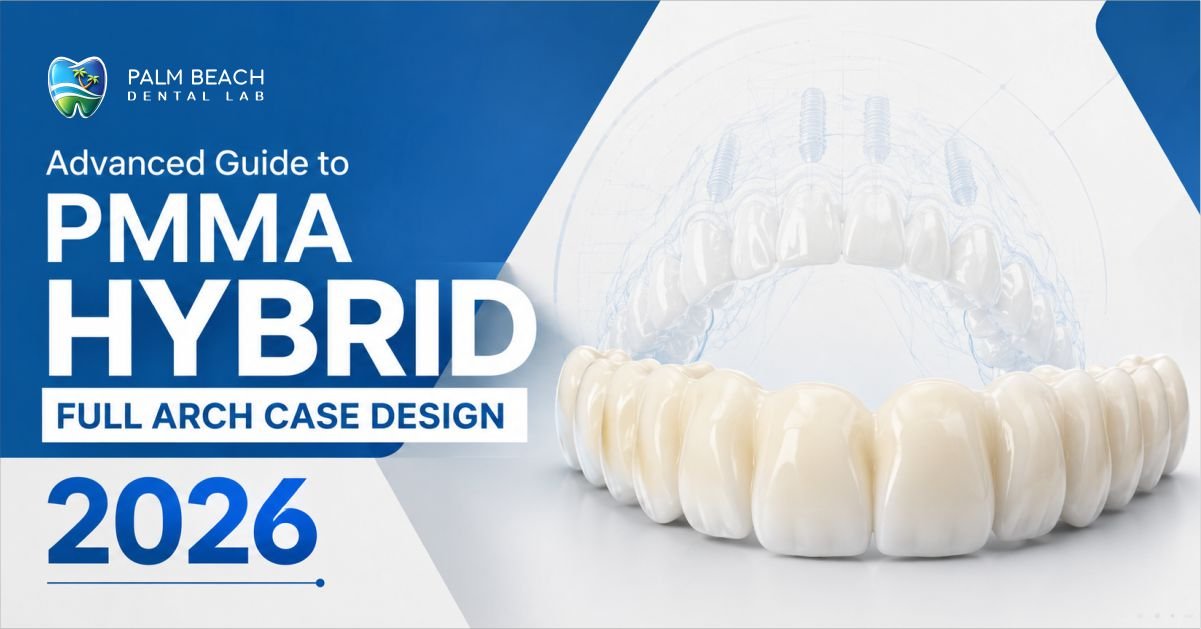
A PMMA hybrid full-arch restoration is a fixed, implant-supported prosthesis made from polymethyl methacrylate. It is commonly used as an immediate or extended provisional during complete-arch implant treatment.
Depending on the patient’s anatomy and treatment goals, the prosthesis may replace teeth alone or both teeth and missing gingival tissue. Although the patient cannot remove a screw-retained hybrid restoration, the dentist can remove it for examination, repair, modification, or professional maintenance.
PMMA is particularly valuable during the provisional phase because it provides an adjustable platform for testing tooth position, lip support, vertical dimension, phonetics, occlusion, tissue contours, and hygiene access before definitive fabrication. Clinical adjustments made during this phase can then be documented and incorporated into the definitive restorative plan.
Clinical takeaway
Treat the PMMA provisional as a clinical prototype. The goal is not only to confirm that it fits, but to determine whether the design is appropriate to reproduce in the definitive restoration.
Why Full-Arch Design Must Begin Before Implant Placement
The intended restorative result should guide surgical and prosthetic planning from the beginning. Placing implants according to available bone without first defining the proposed tooth position and prosthetic envelope can create poor screw access, inadequate material thickness, excessive cantilever, or uncleanable tissue contours.
A prosthetically driven plan starts by establishing the desired incisal edge position, tooth arrangement, occlusal plane, smile line, lip support, prosthetic transition line, and expected tissue replacement. The treatment team can then evaluate whether the available bone, planned reduction, implant distribution, and restorative components support that design.
An implant may integrate successfully yet still create an unfavorable restoration. A facially positioned implant, for example, may force the screw-access opening toward an incisal edge or visible facial surface.
A prosthetically driven workflow works backward from the planned tooth position and restorative envelope rather than asking the restorative team to compensate for implant positions after surgery.
Prosthesis type
Define whether the restoration replaces teeth only or teeth and tissue.
Opposing dentition
Evaluate material, force pattern, and occlusal risk.
Implant distribution
Review spread, angulation, and distal support.
Definitive material
Plan space and contours with the final restoration in mind.
Restorative Space Is More Than a Vertical Measurement
Restorative space should be evaluated as a three-dimensional prosthetic envelope, not only as a vertical measurement. It must accommodate restorative components, adequate PMMA thickness, tooth dimensions, tissue replacement when required, occlusal clearance, and cleanable contours.
There is no single measurement that applies safely to every PMMA hybrid restoration. Space requirements vary according to the implant system, abutment height, temporary cylinders, reinforcement strategy, tooth arrangement, cantilever, opposing dentition, and intended definitive material.
Limited vertical space may force the laboratory to reduce PMMA thickness around a cylinder or beneath a posterior tooth. This creates a mechanically vulnerable area, particularly when that same region receives strong functional contact.
Excessive space can also create problems. A bulky prosthesis may affect speech, reduce comfort, trap plaque, restrict tongue space, or become difficult for the patient to clean. When available space cannot support both the proposed tooth position and safe material thickness, the case should return to clinical review.
Design checkpoint
If maintaining the requested tooth position requires excessive contouring or inadequate PMMA thickness, the case should return for clinical review rather than being silently compensated for in CAD.
Evaluate the Prosthetic Transition Line During Facial Movement
The transition between natural tissue and prosthetic gingiva should be assessed during smiling, speech, and normal facial movement. A transition line that appears hidden on a static cast may become visible when the upper lip reaches maximum elevation.
Evaluate the transition line with the patient at rest, during a natural smile, and at maximum smile rather than relying only on a static intraoral view.
Lip mobility, gingival display, smile line, proposed bone reduction, tissue thickness, lip support, and prosthetic gingival volume all influence the result. Insufficient reduction may leave inadequate restorative space or expose the transition line, while excessive reduction may create unnecessary tissue replacement and a larger prosthesis that is more difficult to clean.
The most attractive result in a static photograph is not always the most functional or maintainable design.
Implant Position, Multi-Unit Abutments, and Screw Access
Implant position influences screw access, cylinder location, material thickness, emergence profile, prosthesis insertion, cantilever, tooth contours, and maintenance access.
A facially positioned implant may place the screw opening near an incisal edge or visible facial surface. A lingually positioned implant can create a bulky palatal contour or reduce tongue space. Posterior angulation may leave limited PMMA around the cylinder or place the access channel in a heavily loaded area.
Multi-unit abutments and angled components may improve the restorative path in selected cases. However, these choices also affect restorative height, tissue emergence, screw-access direction, and the digital component library used by the laboratory.
A useful design question is:
If this exact screw-access position were transferred into the definitive prosthesis, would it still be acceptable?
The team should also confirm that adequate restorative material surrounds each access channel and that the supporting components will remain accessible for future maintenance.
Digital Full-Arch Records Still Require Clinical Verification
Digital capture can improve efficiency, but complete-arch accuracy still depends on how reliably implant positions, soft tissue, jaw relation, and reference datasets are recorded and related to one another. Complete-arch implant capture remains technique-sensitive. Accuracy can be affected by the scanning system, scan bodies, implant number, implant angulation, distribution, operator technique, reference geometry, soft-tissue movement, and data alignment.
The laboratory should compare the implant-position record with the soft-tissue scan, opposing arch, stable jaw-relation record, existing provisional, and approved tooth arrangement. Misalignment between these datasets may produce a restoration that appears correct in software but does not match the clinical position.
When the records do not establish a repeatable relationship, additional verification may involve a conventional impression, splinted verification jig, photogrammetry, prototype restoration, or another validated workflow.
Digital does not mean automatic
A complete digital workflow still depends on accurate implant capture, stable jaw records, correct component libraries, and careful clinical verification.
Palm Beach Dental Lab record review
We compare the submitted implant record with the tissue scan, opposing arch, bite information, component data, facial references, and available provisional records. When these datasets do not establish a clear restorative relationship, we contact the restoring dentist before fabrication.
Jaw Relation and Facial Records Shape the Entire Restoration
An accurate implant scan cannot compensate for an unstable jaw relationship. An incorrect vertical dimension or unreliable maxillomandibular record can affect tooth position, esthetics, phonetics, occlusion, and comfort across the entire arch.
When a patient has worn an unstable denture, lacks reliable occlusal stops, or presents with an altered vertical dimension, a separate verification appointment may be needed before the PMMA design is finalized.
Facial records are equally important. A laboratory viewing only intraoral scans cannot reliably determine facial midline, lip mobility, smile arc, incisal display, or the amount of facial support required.
Full-face frontal view
Helps evaluate facial midline, symmetry, incisal display, and overall tooth position.
Natural and maximum smile
Reveals smile line and lip mobility.
Retracted views
Clarify tooth and tissue relationships.
Profile view
Supports lip and facial-support evaluation.
Cantilever Planning Requires More Than One Formula
Distal cantilever is an important biomechanical concern, but its clinical effect cannot be judged from length alone. Implant distribution, anterior-posterior spread, arch shape, prosthetic material, PMMA thickness, opposing dentition, parafunction, occlusal contacts, and distal tooth position all influence risk.
The goal is not to remove every distal extension. The goal is to avoid a design that concentrates force in a mechanically vulnerable area. When the distal extension is long or posterior PMMA is thin, adding another tooth for appearance may create more risk than benefit.
Repeated distal fractures, progressive wear, screw loosening, or patient discomfort should trigger a design review rather than an identical remake.
A distal tooth should not be added simply because there appears to be space for it. Its position should be evaluated against implant spread, PMMA thickness, opposing forces, and the expected contact pattern.
Occlusal Planning Should Be Patient-Specific
No single occlusal scheme is appropriate for every fixed full-arch implant restoration. Planning should consider the opposing dentition, implant distribution, skeletal relationship, distal extension, parafunction, restorative material, and findings during provisional use.
During delivery, complete seating should be verified before occlusal adjustment. Adjusting a prosthesis that is not fully seated can create a false contact pattern and conceal a fit problem.
After seating is confirmed, contacts should be examined in the planned jaw position and during functional movements. Particular attention should be given to distal extensions, thin PMMA areas, unfavorable cylinder locations, and heavy contacts against natural teeth or another implant-supported arch.
Bruxism and Parafunctional Risk
Repeated fractures, accelerated wear, screw loosening, heavy posterior contacts, or patient-reported discomfort during the provisional phase should be documented and reviewed before definitive fabrication.
Use the PMMA Provisional as a Clinical Prototype
The PMMA provisional should function as the clinical prototype for the definitive prosthesis. It should not be considered approved merely because the patient likes the tooth shade or has worn it without immediate discomfort.
Esthetic evaluation
Review facial midline, incisal display, smile arc, tooth proportions, buccal corridor, gingival display, lip support, and visibility of the prosthetic transition. Photographs should document the approved result.
Phonetic evaluation
Persistent speech problems may indicate errors in incisor position, vertical dimension, palatal contour, horizontal overlap, or airflow. Ongoing phonetic difficulty should be addressed before definitive fabrication.
Functional evaluation
Review jaw-position repeatability, mastication, comfort, contact stability, excursive interferences, wear patterns, repairs, and screw stability. Every meaningful adjustment should be documented.
Hygiene evaluation
The patient should demonstrate that they can clean beneath the restoration and around the supporting components. Copying difficult provisional contours into zirconia will preserve the hygiene problem rather than correct it.
Transfer the clinically successful version
When tooth position, occlusion, tissue contours, vertical dimension, or other features have been changed clinically, the updated provisional should become the reference for definitive fabrication whenever possible. Transferring an earlier CAD design can reintroduce problems that were already corrected chairside.
When Should a PMMA Full-Arch Design Return for Review?
A PMMA design should return for clinical review when completing the requested design would require the laboratory to compensate for an unresolved restorative conflict rather than simply fabricate the approved plan.
- Inadequate PMMA surrounding a restorative cylinder
- Facial or incisal screw access that compromises the planned restoration
- Implant, tissue, or provisional datasets that do not align
- A jaw relation that cannot be reproduced reliably
- A prosthetic transition line visible during maximum smile
- A distal extension combined with thin PMMA or heavy functional contact
- Intaglio contours that cannot be cleaned predictably
These findings should trigger communication with the treatment team rather than hidden compensation in CAD.
Intaglio Design Must Support Daily Hygiene
The tissue-facing surface affects plaque retention, cleaning access, patient comfort, and professional maintenance. Esthetic facial contours should never be created at the expense of an intaglio surface that the patient cannot clean.
The provisional phase should be used to confirm that the patient can actually access the intaglio surface with the recommended hygiene aids. If a contour repeatedly traps food or cannot be cleaned predictably, it should be modified before definitive transfer.
Regardless of the selected tissue relationship, the intaglio surface should be smooth, accessible, easy to explain, compatible with appropriate hygiene aids, and free from unnecessary plaque-retentive concavities.
PMMA Versus Zirconia: Different Materials, Different Roles
PMMA and zirconia should not be compared only by asking which material is stronger. They usually serve different purposes within a full-arch treatment sequence.
PMMA is particularly valuable when the design still requires testing. Zirconia is commonly selected for definitive complete-arch restorations because of its strength, wear resistance, color stability, and ability to reproduce an approved design.
Zirconia cannot correct an inaccurate jaw relation, unfavorable screw access, weak implant-position data, or uncleanable contours. Material selection should follow successful provisional validation.
Design factor | PMMA provisional | Zirconia definitive restoration |
|---|---|---|
Main purpose | Clinical testing and provisional
function | Long-term definitive restoration |
Adjustment | Easier to modify | Requires controlled adjustment |
Repair | Usually easier | Can be more limited |
Diagnostic value | High | Relies on accurate design transfer |
Wear resistance | Lower during extended use | Generally higher |
Color stability | Suitable for provisional treatment | Better long-term stability |
Best timing | During design validation and patient adaptation | After esthetic, functional, phonetic, and hygiene approval |
Clinical Example: Limited Posterior Restorative Space
Design concern: Limited posterior restorative space
CAD finding: Reduced PMMA thickness around posterior restorative components
Potential risk: Thin material combined with posterior functional loading
Design response: Posterior arrangement reviewed before milling
In one full-arch case, the posterior region provided limited space around the restorative cylinders. Maintaining the original tooth arrangement would have required thin PMMA beneath the occlusal surfaces and around important connection areas.
The restoration looked acceptable from the facial view. However, a cross-sectional CAD review revealed a mechanically weak posterior segment. Milling the design without further discussion would have transferred that weakness directly into the provisional.
The dentist and laboratory reviewed the component height, posterior tooth position, occlusal plane, distal extension, and intended definitive material. The posterior arrangement was modified to improve material distribution while protecting the primary esthetic goals.
When available space cannot support both the requested tooth position and safe material thickness, the design must return to the treatment team.
PMMA Full-Arch Case Submission Checklist
Dentists do not need to submit every possible digital record for every case. They do need to provide enough verified information to remove guesswork from the design. The following records reflect the information Palm Beach Dental Lab commonly reviews before beginning a PMMA full-arch workflow.
Implant and component information
- Implant system and platform
- Implant-level or abutment-level workflow
- Multi-unit abutment details
- Scan-body system
- Temporary cylinder information
- Manufacturer-specific screw and torque information when applicable
Clinical and digital records
- Verified implant-position record
- Soft-tissue scan
- Opposing arch
- Stable jaw-relation record
- Existing or adjusted provisional scan
- Facial photographs or facial scan
Design instructions
- Dental midline and incisal edge position
- Tooth and gingival shades
- Lip-support requirements
- Distal tooth limit
- Occlusal instructions
- Screw-access and hygiene concerns
Laboratory review matters
A missing record identified during design can usually be corrected. An unresolved clinical relationship discovered after fabrication is considerably more difficult to manage.
What Predictable Full-Arch Cases Have in Common
Across predictable full-arch workflows, successful cases are rarely defined by one scanner, implant system, or restorative material.
Predictable cases begin with a clearly defined prosthetic objective. The laboratory receives accurate records, understands the restorative components, and can relate implant positions to the proposed teeth and facial references.
The provisional is treated as a clinical test rather than a formality. Adjustments are documented, risks are discussed, and the definitive restoration is designed from the version that has actually succeeded in the patient’s mouth.
Technology can make this process faster and easier to reproduce. It cannot replace clinical judgment, verification, or communication.
How Palm Beach Dental Lab Supports Full-Arch Cases
Palm Beach Dental Lab supports the provisional-to-definitive workflow by helping identify restorative questions while the design is still adjustable.
01
Review the submitted records
We check the available implant, component, bite, tissue, facial, and provisional information before design.
02
Flag design concerns early
Restorative-space conflicts, questionable screw access, missing records, and unclear references are discussed before milling.
03
Support provisional evaluation
The PMMA restoration is designed to help the clinical team assess esthetics, function, phonetics, and hygiene.
04
Transfer the approved result
Clinically approved changes can guide the definitive design when the updated records and instructions are supplied.
Have a PMMA full-arch case with limited restorative space, difficult implant angulation, questionable screw access, or records that do not align clearly?
Send your available scans, component information, and provisional references to Palm Beach Dental Lab for a pre-production case review.
Frequently Asked Questions
A PMMA provisional allows the treatment team to test the planned restoration before definitive fabrication. It can reveal problems involving esthetics, phonetics, vertical dimension, occlusion, tissue contours, component positions, hygiene access, and patient adaptation.
A screw-retained PMMA hybrid restoration is fixed for the patient. A dental professional can remove it for examination, repair, adjustment, or maintenance.
There is no universal service period for every patient. Duration depends on the treatment plan, material thickness, implant distribution, cantilever, opposing dentition, occlusion, parafunction, hygiene, and maintenance.
Possible contributing factors include inadequate material thickness, excessive distal extension, heavy contacts, parafunction, weak cylinder areas, unfavorable implant distribution, and manufacturing or pickup errors.
Intraoral scanning can support complete-arch workflows, but accuracy depends on the scanner, scan bodies, implant arrangement, scanning strategy, reference geometry, and operator technique. Verification is appropriate when fit, alignment, or repeatability remains uncertain.
Definitive fabrication should begin after the provisional has been approved for seating, esthetics, phonetics, vertical dimension, occlusion, hygiene access, tissue response, and patient comfort.
Conclusion
Predictable PMMA hybrid full-arch case design depends on coordinating surgical planning, restorative decisions, laboratory design, and long-term maintenance.
The restoration must provide sufficient space, verified implant-position data, favorable screw access, stable jaw relations, controlled occlusion, cleanable tissue contours, and enough material around critical components.
The provisional phase allows the treatment team to identify problems while changes remain manageable. When the provisional has been clinically evaluated, adjusted, documented, and accurately captured, it becomes a much stronger reference for transferring the approved esthetic, functional, and hygiene design into the definitive prosthesis.
Planning a Complex Full-Arch Implant Case?
Palm Beach Dental Lab can review your implant and component information, digital records, facial references, jaw relation, and restorative objectives before the case enters production. Early collaboration can help identify questions while the design is still flexible.