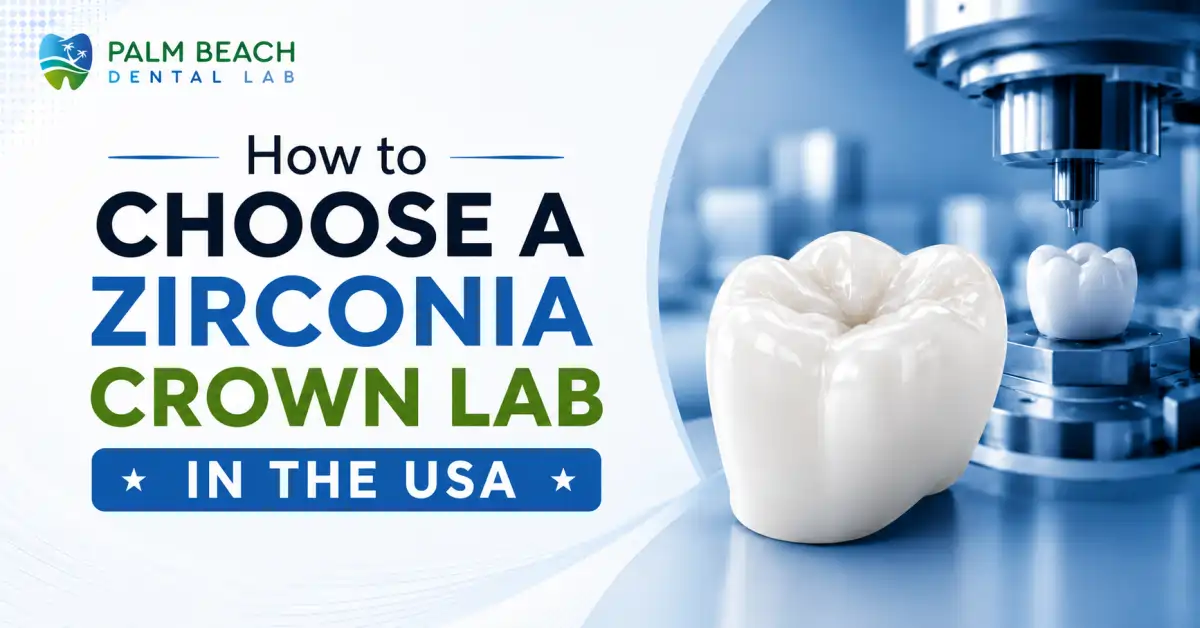
Finding a dependable Zirconia Crown Lab isn’t just about getting crowns made—it’s about choosing a partner who helps you deliver exceptional patient care.
Every restoration you place reflects your clinical standards and professional reputation. A crown that fits accurately, matches naturally, and arrives on time can strengthen patient trust. A poorly made restoration can lead to extra chair time, unnecessary adjustments, remakes, and frustration for both you and your patient.
With many dental laboratories serving practices across the United States, the challenge is not simply finding a provider. It is determining whether the laboratory’s materials, workflow, quality checks, communication, and delivery standards align with your clinical expectations.
The difference between laboratories is often revealed through repeatability: how consistently they manage margins, contacts, occlusion, shade, communication, and delivery from one case to the next.
This guide explains exactly what every dentist should evaluate before selecting a zirconia crown lab. Whether you’re considering a new laboratory or reviewing your current one, these insights will help you make a more confident decision.
What Is a Zirconia Crown Lab?
A zirconia crown lab is a specialized dental laboratory that designs and fabricates custom zirconia restorations using digital technologies, precision manufacturing equipment, and skilled laboratory technicians.
Unlike traditional workflows that rely heavily on manual impressions and hand-crafted processes, many modern laboratories use digital impressions, CAD/CAM software, and computer-controlled milling systems to improve consistency throughout the production process. These technologies help create restorations that are designed to fit accurately while supporting both function and esthetics.
Depending on the laboratory’s capabilities, services may include:
- Custom zirconia crowns
- Monolithic zirconia crowns
- Premium zirconia crowns
- Multilayer zirconia crowns
- High-translucency zirconia restorations
- Implant-supported zirconia restorations
- Digital impression workflows
- Custom shade matching and characterization
- Quality inspection before case delivery
However, producing a zirconia crown involves much more than operating a milling machine. Accurate restoration design requires careful evaluation of the prescription, preparation margins, occlusion, material selection, and esthetic requirements. Experienced technicians play a critical role in ensuring every restoration meets the clinician’s expectations before it reaches the practice.
Why Your Choice of Dental Lab Matters
Your dental laboratory has a direct influence on treatment efficiency, restoration quality, and the overall experience you deliver to patients.
A well-manufactured zirconia crown should fit predictably, require minimal adjustment, and blend naturally with the patient’s dentition. Achieving that level of consistency depends on far more than premium materials alone. It requires an organized workflow, experienced technicians, reliable communication, and thorough quality control.
Published evidence suggests that digital workflows can improve efficiency in some single-crown and implant-crown applications, although outcomes vary according to the workflow, operator, scanner, and clinical situation. Digital technology is most effective when supported by accurate scans, clear prescriptions, appropriate material selection, technician review, and structured quality control.
Rather than comparing laboratories solely on price or turnaround time, it’s worth evaluating how each lab contributes to your clinical workflow and long-term efficiency.
A dependable zirconia crown laboratory can help your practice:
- Reduce chairside adjustments
- Improve marginal accuracy
- Achieve more predictable shade matching
- Minimize remakes
- Maintain reliable delivery schedules
- Simplify digital case submissions
- Improve communication on complex cases
- Increase patient confidence in restorative treatment
Over time, a laboratory that consistently delivers quality restorations becomes an extension of your clinical team rather than simply another supplier.
Experience Matters More Than Marketing
Professional memberships can provide useful context, but membership alone does not demonstrate restoration quality. Dentists should also ask how a laboratory supports technician training, continuing education, documented production protocols, and ongoing quality improvement.
The laboratories that earn long-term trust typically follow standardized production protocols, maintain experienced technical teams, and inspect every restoration before shipment. Their focus extends beyond manufacturing crowns to supporting predictable clinical outcomes.
For example, two laboratories may use the same CAD/CAM system and zirconia material, yet produce noticeably different results because of differences in digital design, margin evaluation, sintering protocols, finishing techniques, and quality assurance.
Experienced laboratories also recognize when collaboration is necessary. If a margin is unclear, occlusal space is limited, or additional case information is required, proactive communication before production can prevent costly remakes later.
At Palm Beach Dental Lab, we’ve found that successful laboratory partnerships are built on consistency rather than promises. By combining digital precision with skilled craftsmanship and open communication, our goal is to provide restorations that support efficient treatment and predictable outcomes for every case.
10 Things Every Dentist Should Evaluate Before Choosing a Zirconia Crown Lab
Many laboratories advertise similar services, making it difficult to identify meaningful differences. Instead of relying on marketing claims, evaluate how each laboratory approaches technology, quality control, communication, and long-term collaboration.
The following factors can help you compare laboratories more effectively.
1. Digital Workflow and CAD/CAM Technology
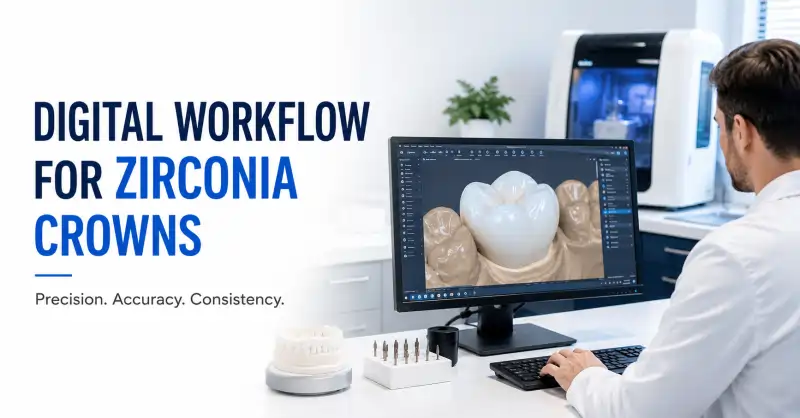
Digital dentistry has transformed the way restorations are designed and manufactured. Laboratories that fully integrate digital workflows are often able to deliver greater consistency while simplifying communication with dental practices.
From digital impression files to computer-aided design and precision milling, each step contributes to a more standardized production process.
When evaluating a laboratory, consider asking:
- Which intraoral scanners are compatible with your workflow?
- Is every restoration designed using CAD/CAM software?
- How are preparation margins verified before milling?
- Do technicians review digital designs before production begins?
Digital workflows cannot replace clinical judgment, but they can significantly improve efficiency when combined with experienced technical oversight.
2. Precision Fit Matters More Than Fast Delivery
A laboratory that delivers a crown quickly provides little value if the restoration requires extensive adjustments at delivery.
Marginal discrepancies, open contacts, or occlusal inaccuracies increase chairside time and may require additional appointments or remakes. Over time, these issues can reduce productivity and affect patient satisfaction.
Instead of asking only how quickly a laboratory can complete a case, ask how consistently it achieves an accurate fit.
Useful questions include:
- How is marginal accuracy verified?
- Are proximal contacts evaluated before shipping?
- Is occlusion reviewed during quality inspection?
- What percentage of cases require remakes?
Consistent precision generally creates greater long-term efficiency than occasional rush services.
3. The Quality of Zirconia Materials
Not every zirconia material performs the same way. Modern zirconia systems are available in multiple formulations that balance strength, translucency, and esthetics for different clinical situations.
A knowledgeable laboratory should recommend materials based on the restorative requirements of each individual case rather than relying on a single option for every patient.
For example:
- Monolithic zirconia is often selected for posterior restorations where durability is a priority.
- Multilayer zirconia offers more natural shade transitions for highly esthetic cases.
- High-translucency zirconia may be preferred for anterior restorations where appearance is especially important.
Understanding these differences demonstrates technical expertise and a patient-centered approach to restorative dentistry.
4. Quality Control Should Be Built Into Every Case
Quality assurance is one of the clearest indicators of a professional dental laboratory.
Before any restoration is packaged and shipped, each case should undergo a structured inspection process to verify that it meets the prescribed clinical requirements.
Typical quality control checkpoints include:
- Marginal integrity
- Proximal contacts
- Occlusal relationships
- Shade verification
- Surface finish
- Overall restoration fit
Although no manufacturing process is completely error-free, consistent inspection procedures help reduce the likelihood of remakes and support more predictable clinical outcomes.
5. Communication Can Prevent Problems Before They Happen
Even with accurate impressions and digital workflows, restorative cases occasionally present challenges.
A preparation margin may require clarification. An implant component may need verification. Limited occlusal clearance might affect material selection.
When communication happens early, many potential issues can be resolved before production begins.
Look for a laboratory that provides:
- Direct access to knowledgeable technicians
- Prompt responses to clinical questions
- Case updates when additional information is needed
- Collaborative support for complex restorative treatments
The strongest laboratory relationships are built on open communication and mutual trust. When your laboratory understands your clinical preferences and treatment goals, collaboration becomes more efficient, helping deliver better outcomes for both your practice and your patients.
6. Consistent Turnaround Time Is More Valuable Than Occasional Speed
Meeting patient expectations often depends on maintaining a predictable schedule. While every dentist appreciates a laboratory that can accommodate urgent cases, consistently delivering restorations on time is generally more valuable than offering occasional rush services.
Delayed cases can affect more than a single appointment. They may require rescheduling patients, adjusting treatment plans, and creating unnecessary disruptions for both the practice and the patient.
When comparing laboratories, ask questions such as:
- What is your standard turnaround time for zirconia crowns?
- How are urgent cases managed?
- Do you consistently meet your published delivery schedules?
- How do you communicate if an unexpected delay occurs?
A dependable laboratory values transparency. If additional time is required because of a complex case or quality concern, proactive communication allows the practice to plan accordingly.
7. Experience With Complex Restorative Cases
Most laboratories can fabricate a routine single-unit crown. More advanced restorative cases, however, require a greater level of planning, communication, and technical expertise.
Treatments involving implants, cosmetic smile rehabilitations, multiple-unit restorations, or full-mouth rehabilitation often require close collaboration between the dentist and laboratory throughout the treatment process.
A laboratory experienced in complex cases should be comfortable supporting:
- Implant-supported zirconia restorations
- Full-mouth rehabilitation
- Cosmetic anterior restorations
- Digital smile design collaboration
- Multi-unit bridgework
- Occlusal rehabilitation
A Practical Example
Consider a patient who requires replacement of a fractured upper central incisor. While strength remains important, esthetics often become the primary concern because the restoration is positioned within the patient’s smile line.
In contrast, restoring a mandibular first molar usually prioritizes durability and resistance to occlusal forces.
An experienced laboratory recognizes these differences and may recommend different zirconia materials or finishing techniques based on the clinical requirements rather than applying the same approach to every case.
That level of collaboration can contribute to more predictable restorative outcomes.
8. Understand the Laboratory's Remake Policy
Even with accurate impressions, digital workflows, and careful planning, adjustments or remakes may occasionally be necessary.
The difference between an average laboratory and a trusted partner is often reflected in how these situations are handled.
Before beginning a long-term partnership, ask:
- What is your remake policy?
- How are remake requests evaluated?
- Will the original technician review the case?
- How is feedback incorporated into future restorations?
A transparent remake process demonstrates a commitment to continuous improvement rather than simply replacing a restoration.
More importantly, laboratories that analyze the root cause of a remake can help reduce similar issues in future cases.
9. Look Beyond the Initial Price
Laboratory fees are naturally an important consideration, but they should be evaluated alongside the overall value a laboratory provides.
A lower-priced restoration may appear cost-effective initially, yet repeated adjustments, remakes, additional appointments, and lost chair time can significantly increase the total cost of treatment.
Instead of asking:
“Which laboratory offers the lowest price?”
Consider asking:
“Which laboratory consistently helps my practice work more efficiently while delivering dependable restorative outcomes?”
A restoration that seats accurately on the first appointment often saves considerably more time and resources than a lower-cost alternative requiring multiple adjustments.
10. Choose a Laboratory That Builds Long-Term Partnerships
The strongest laboratory relationships develop over time.
As technicians become familiar with your preparation style, preferred occlusal scheme, shade preferences, and restorative philosophy, communication becomes more efficient and restorations often require fewer adjustments.
Rather than functioning solely as a manufacturing provider, a dependable laboratory becomes an extension of your restorative team.
Long-term collaboration may provide benefits such as:
- Better understanding of your clinical preferences
- More consistent restorative outcomes
- Faster communication on complex cases
- Improved shade consistency
- Streamlined digital case submissions
- Greater confidence when treatment planning advanced restorations
Strong partnerships are built through trust, communication, and shared clinical goals.
Zirconia Crown Case Submission Checklist
A laboratory can only work with the clinical information it receives. Before submitting a zirconia crown case, confirm that the laboratory has:
- A complete and readable digital scan or conventional impression
- Clearly visible preparation margins
- Adequate occlusal-clearance information
- An accurate opposing arch and bite record
- The prescribed shade and zirconia indication
- Shade photographs when characterization is important
- Implant-system and component information, when applicable
- Written instructions for contacts, occlusion and esthetic expectations
When essential information is missing, production may be delayed while the laboratory requests clarification. A complete submission helps the dentist and technician identify potential concerns before design and manufacturing begin.
Questions Every Dentist Should Ask Before Sending a Case
Selecting a laboratory involves more than reviewing pricing or turnaround times. Asking thoughtful questions can provide valuable insight into the laboratory’s workflow and commitment to quality.
Consider discussing the following before sending your first case:
- Which intraoral scanners are compatible with your workflow?
- What zirconia materials do you routinely recommend?
- How is crown fit verified before shipment?
- What quality control procedures are completed before delivery?
- What is your average turnaround time?
- How are complex restorative cases managed?
- Can I communicate directly with a technician when necessary?
- What is your process for handling remakes or adjustments?
The quality of the answers often reveals as much about a laboratory as the restorations themselves.
Common Mistakes Dentists Make When Choosing a Dental Lab
Selecting the wrong laboratory doesn’t always result from poor workmanship. In many cases, it begins with overlooking important evaluation criteria.
Choosing Price Before Performance
While cost plays a role in every practice, selecting a laboratory based solely on pricing can lead to increased chairside adjustments, remakes, and patient dissatisfaction.
Evaluating overall value rather than the initial laboratory fee often produces better long-term results.
Ignoring Digital Compatibility
As digital dentistry continues to evolve, compatibility between your intraoral scanner and the laboratory’s workflow becomes increasingly important.
Laboratories that support your scanner platform or accept open STL files can simplify case submission, improve communication, and reduce delays associated with conventional impression shipping.
Published evidence suggests that digital impressions can improve efficiency in some single-crown workflows, although results vary by restoration type and workflow. A systematic review comparing digital and conventional impression workflows found that neither method is universally faster, reinforcing the importance of choosing a laboratory with a well-integrated digital process.
Assuming Every Laboratory Uses Similar Standards
Many laboratories advertise CAD/CAM technology, premium zirconia materials, and experienced technicians.
However, identical equipment does not guarantee identical outcomes.
Differences in technician training, restoration design, sintering protocols, finishing techniques, and quality assurance procedures all contribute to the consistency of the final restoration.
Understanding how a laboratory works is often more valuable than simply knowing which equipment it owns.
Sending Every Case Without First Evaluating the Partnership
Before transferring your entire restorative workflow to a new laboratory, consider sending a limited number of cases first.
Evaluate:
- Crown fit
- Marginal adaptation
- Shade accuracy
- Communication
- Turnaround consistency
- Packaging
- Overall experience
A trial period allows both the dentist and laboratory to establish expectations before developing a long-term partnership.
A Five-Case Method for Evaluating a New Zirconia Crown Lab
Before moving your complete restorative workflow to a new laboratory, consider evaluating five representative cases. Include routine and moderately challenging restorations so you can assess consistency across different clinical situations.
Record the following after each case:
| Evaluation area | What to record |
|---|---|
| Crown fit | No adjustment, minor adjustment or major adjustment |
| Proximal contacts | Open, accurate or excessively tight |
| Occlusion | No adjustment, minor adjustment or major adjustment |
| Shade and characterization | Accepted, modified or remade |
| Turnaround | Early, on schedule or delayed |
| Communication | Proactive, responsive or difficult to reach |
| Final outcome | Seated successfully, adjusted or remade |
Avoid judging a laboratory from only one unusually successful or difficult case. After five cases, review patterns in fit, communication, delivery, and remake handling. Consistency across several cases provides a more useful indication of whether the laboratory is suitable for a long-term partnership.
How Palm Beach Dental Lab Supports Dentists
At Palm Beach Dental Lab, we combine digital case acceptance, CAD/CAM design, experienced technicians, case-specific zirconia selection, comprehensive quality checks, and direct technical support.
Before shipment, each restoration is reviewed for marginal integrity, proximal contacts, occlusion, shade, surface finish, and overall quality. Our team also communicates with dentists when clarification is needed regarding margins, implant components, material selection, or restoration design.
We accept digital cases through iTero, DEXIS, CS Connect, 3Shape TRIOS, Medit Link, Dentsply Sirona-compatible workflows, and open STL files. Our standard zirconia production time is two business days; however, complex cases, extensive characterization, or cases requiring additional information may take longer. Dentists can contact our technical team for case-planning support and an estimated completion time.
This collaborative approach helps practices simplify case submission, reduce avoidable adjustments, and achieve more consistent restorative outcomes.
Final Thoughts
Choosing the right zirconia crown lab requires looking beyond price and turnaround time. Crown fit, material selection, digital compatibility, quality control, communication, and technician expertise all influence the consistency of restorative outcomes.
Before establishing a long-term partnership, review the laboratory’s workflow, ask detailed questions, and begin with a small number of representative cases. The right laboratory should communicate clearly, support your clinical process, and deliver restorations you can place with confidence.
Thank you for reading this guide. To discuss an upcoming zirconia case or learn more about our digital workflow and technical support, contact Palm Beach Dental Lab today.
Ready to Discuss Your Next Zirconia Case?
Have questions about materials, digital scans, margins, or restoration design? Speak with the Palm Beach Dental Lab technical team before submitting your case.
Frequently Asked Questions
Look for a laboratory that combines advanced CAD/CAM technology, premium zirconia materials, experienced technicians, structured quality control, reliable turnaround times, and responsive communication. The goal is to choose a partner that consistently delivers restorations with predictable fit and esthetics while supporting your clinical workflow.
Digital workflows use intraoral scans, CAD/CAM software, and precision milling to improve consistency throughout the manufacturing process. They can simplify communication between dentists and laboratories while reducing many of the variables associated with traditional impression techniques.
Review the laboratory’s digital capabilities, technician experience, quality assurance procedures, turnaround consistency, communication practices, and experience with complex restorative cases. Sending a small number of trial cases before transferring all restorative work is often a practical way to evaluate performance.
Monolithic zirconia crowns are designed primarily for strength and are commonly selected for posterior restorations that experience higher biting forces. Multilayer zirconia crowns provide more natural shade transitions and translucency, making them well suited for highly aesthetic anterior restorations.
Yes. Laboratories that combine accurate digital workflows, experienced technicians, and thorough quality control often produce restorations with improved marginal fit and occlusion. This can reduce chairside adjustments, improve appointment efficiency, and enhance the patient experience.
Clear communication plays an important role in successful restorative treatment. Discussing preparation details, shade expectations, occlusion, implant components, and complex case requirements before production begins can help prevent delays and reduce the likelihood of remakes.