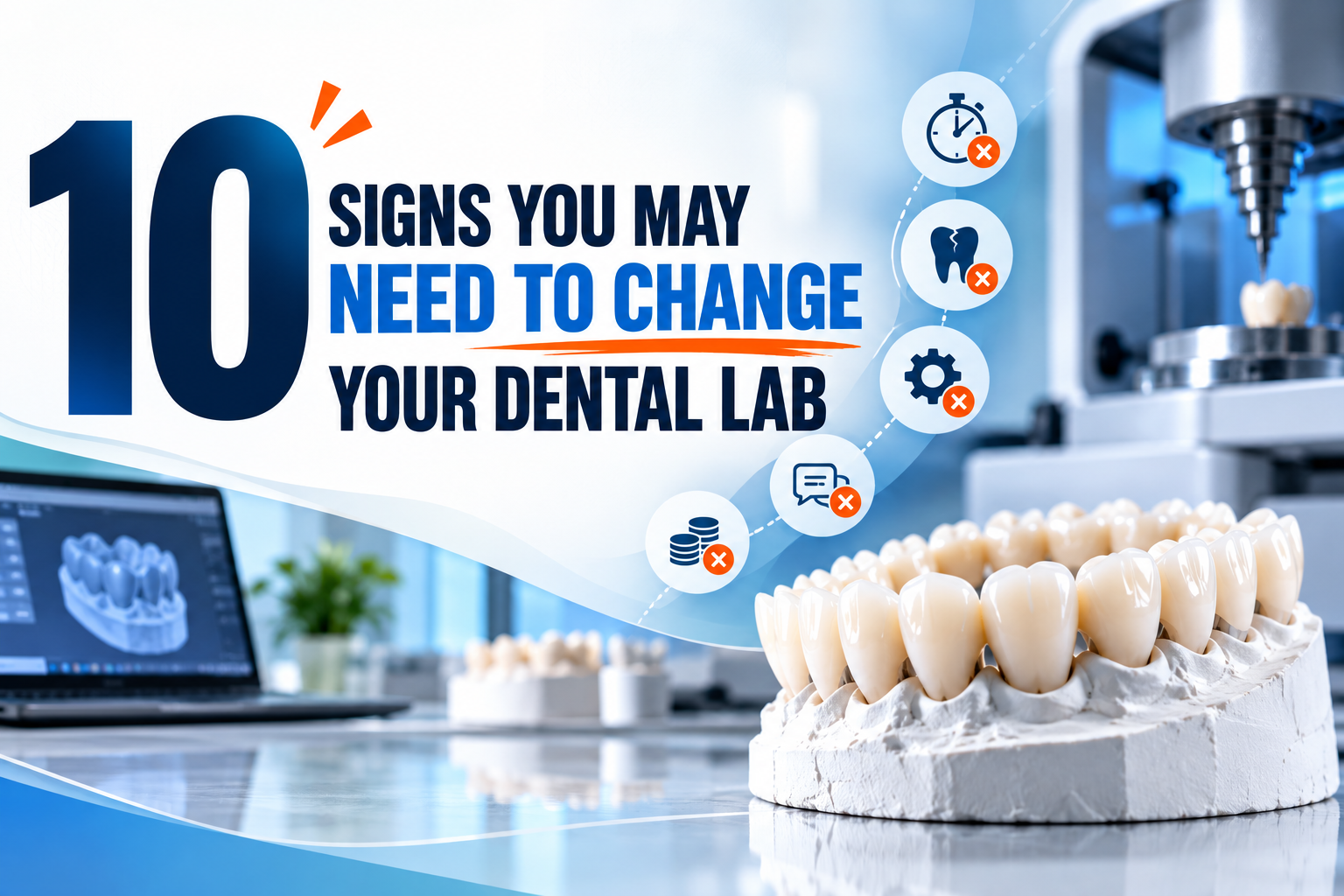
Knowing when to change your dental lab is not about one delayed case or a single crown that needs adjustment. Occasional issues can happen with any laboratory. The real concern begins when the same problems continue across multiple cases.
Repeated remakes, inconsistent fit, frequent occlusal or contact adjustments, missed turnaround times, poor communication, or difficulty managing digital and implant cases can affect your practice workflow. Over time, these issues may increase chair time, disrupt scheduling, and make restorative cases less predictable.
A reliable dental laboratory should support your practice with consistent quality, clear communication, realistic turnaround times, and dependable technical support. In this guide, we explain 10 practical signs that may indicate it is time to evaluate your current dental lab and determine whether another laboratory would better support your practice.
Technical Review
This guide considers practical factors involved in dentist-laboratory workflows, including prescriptions, digital scans, restoration fit, contacts, occlusion, implant cases, remakes, turnaround time, and laboratory communication.
Prepared by: Palm Beach Dental Lab
Location: Royal Palm Beach, Florida
Technical Reviewer: Vijay Patel, Palm Beach Dental Lab
The examples below are illustrative dental-practice scenarios and are not individual patient case reports.
How Should You Evaluate Your Current Dental Lab?
Before changing laboratories, review your recent experience objectively.
The relationship between a dentist and dental laboratory depends on both clinical information and laboratory execution. Accurate impressions or scans, clear prescriptions, appropriate bite records, photographs, material selection, and communication can all influence the final restoration.
The American College of Prosthodontists also recognizes the importance of effective collaboration between dentists and dental laboratories. For external reference, you can link the phrase dentist-laboratory relationship to the American College of Prosthodontists’ guidance on dental laboratory and dentist relationships.
When evaluating your laboratory, review:
- Restoration fit and margins
- Contacts and occlusion
- Shade and contours
- Remake frequency
- Chairside adjustments
- Turnaround time
- Communication
- Digital workflow compatibility
- Implant and complex-case support
- Pricing transparency
The goal is to identify a pattern rather than judge a laboratory from one difficult case.
1. Your Cases Frequently Need Significant Adjustments
Every dental practice will occasionally receive a restoration that requires adjustment. That alone is not necessarily a warning sign.
The concern begins when significant corrections become routine.
Common recurring problems may include:
- Tight or open proximal contacts
- Heavy occlusion
- Marginal discrepancies
- Seating difficulties
- Incorrect contours
- Shade differences
- Emergence-profile concerns
Before assuming the problem is entirely laboratory-related, review the complete workflow. Preparation design, scan or impression quality, bite records, prescription details, material selection, laboratory design, and fabrication can all influence the result.
Example: One posterior crown arrives with a tight contact. That may simply be an isolated case. However, if several similar crowns repeatedly require substantial contact adjustment despite accurate scans and clear instructions, the pattern should be investigated.
A dependable lab should be willing to review recurring problems and help identify their cause.
If the same issues continue after accurate clinical records and clear feedback have been provided, it may be time to compare other dental lab options.
2. Turnaround Times Are Repeatedly Affecting Your Schedule
Reliable dental lab turnaround times help practices schedule treatment with greater confidence.
Occasional delays can happen because of material availability, case complexity, shipping, or the need for additional information. Repeated delays are different.
Late cases can lead to:
- Rescheduled appointments
- Longer use of temporary restorations
- Additional administrative work
- Delayed treatment completion
- Disrupted chair schedules
Example: Your laboratory quotes seven business days for a routine case. One restoration arrives a day late because additional information was required, and the lab communicated this immediately. That is very different from cases routinely arriving two or three days late without notice.
A good laboratory should provide realistic turnaround expectations and communicate promptly when circumstances change.
If missed delivery dates have become normal rather than occasional, the issue can affect both practice efficiency and patient scheduling.
3. Communication With Your Dental Lab Is Difficult
Clear communication is one of the most important parts of the dentist-laboratory relationship.
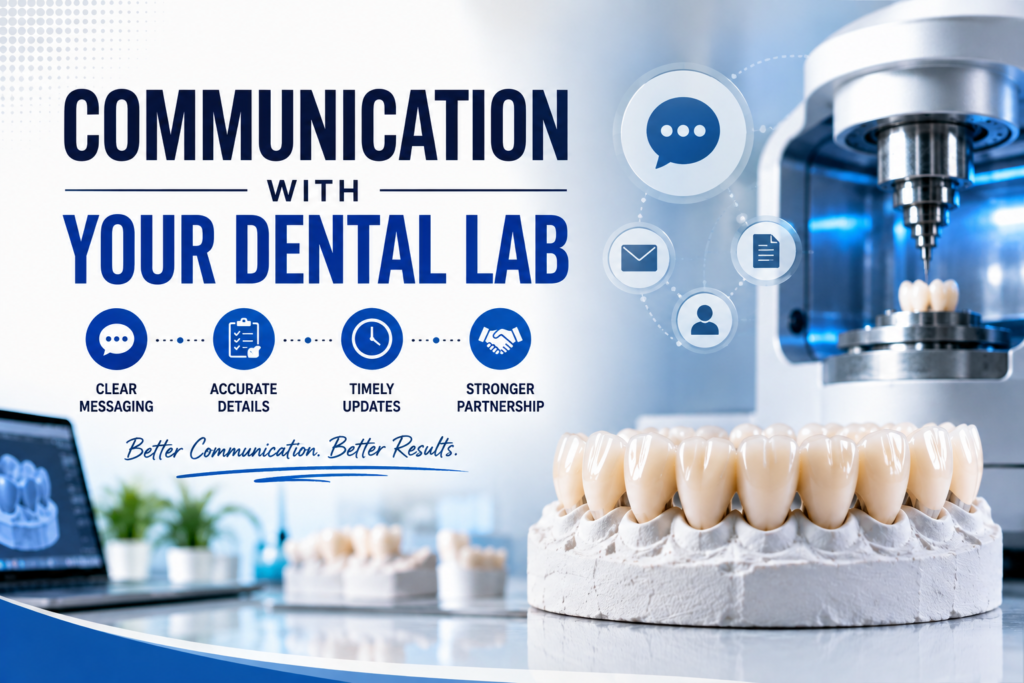
A laboratory may need information about:
- Material selection
- Margin design
- Shade
- Occlusal requirements
- Implant components
- Photographs
- Contours
- Case-specific preferences
The laboratory should also contact your practice when information is incomplete or unclear.
Warning signs include:
- Calls or emails regularly going unanswered
- Case updates being difficult to obtain
- Technical questions remaining unresolved
- Important prescription details being overlooked
- Your team repeatedly explaining the same preferences
Example: A digital case is submitted without adequate occlusal information. A collaborative laboratory identifies the missing information and contacts the practice before fabrication begins.
A poor communication process may allow the case to progress until the problem becomes apparent at delivery.
Effective communication should help prevent avoidable issues rather than simply explain them afterwards.
4. Your Lab Struggles With Digital Dental Workflows
Digital dentistry has changed how many practices communicate with dental laboratories.
Modern workflows may include:
- Intraoral scanners
- Digital impressions
- STL files
- CAD/CAM systems
- Clinical photography
- Implant scan bodies
- Digital models
- Virtual case review
- Full-arch digital workflows
Digital technology can improve efficiency, but only when the practice and laboratory can work together effectively.
Peer-reviewed research in prosthodontics has examined the potential time and workflow benefits of digital approaches, particularly in fixed and implant prosthodontics. You can externally link the phrase digital dental workflow to relevant research from The Journal of Prosthetic Dentistry.
When reviewing your lab’s digital capabilities, ask:
- Which scanners do you support?
- Which file formats can you receive?
- How are photographs submitted?
- Can digital designs be reviewed?
- How are implant scan-body cases managed?
- What happens when a scan is incomplete?
Example: Investing in an intraoral scanner will not significantly improve efficiency if every case requires repeated file conversions, manual workarounds, or multiple phone calls before the laboratory can begin.
The lab should fit naturally into your digital workflow.
5. Complex Restorative or Implant Cases Are Difficult to Coordinate
Not every dental laboratory has the same level of experience with every type of case.
A laboratory that performs well with routine single-unit crowns may not necessarily be the right partner for:
- Implant restorations
- Custom abutments
- Multi-unit bridges
- Full-arch cases
- All-on-X restorations
- Cosmetic rehabilitation
- Complex restorative treatment
These cases often require additional planning, communication, implant-system knowledge, digital workflows, and coordination.
Example: A lab may consistently produce good zirconia crowns but have limited experience coordinating a full-arch implant case involving scan bodies, multi-unit abutments, prototypes, verification, and final fabrication.
That does not necessarily make it a poor laboratory.
It may simply mean your practice has grown beyond the laboratory’s current capabilities.
Your dental lab should be equipped for the types of cases you provide today.
6. Restoration Quality Is Inconsistent From Case to Case
Consistency is often more important than receiving one outstanding restoration.
Your dental team should have a reasonable idea of what to expect when the next case arrives.
Review recurring performance in:
- Marginal fit
- Internal fit
- Contacts
- Occlusion
- Anatomy
- Contours
- Shade
- Surface texture
- Finishing
- Overall restoration quality
Example: If nine similar restorations seat predictably and one requires adjustment, investigate the individual case.
If results vary significantly from case to case without a clear reason, the laboratory’s quality-control process may need closer review.
Documenting recurring issues is valuable because it makes discussions with the laboratory more objective.
Instead of saying, “The cases haven’t been good lately,” you can identify specific patterns involving contacts, fit, shade, occlusion, or remakes.
7. Pricing Is Increasing Without Clear Value
Higher laboratory fees alone are not a strong reason to change dental labs.
The important question is what your practice receives for the price.
Consider the total cost of the laboratory relationship, including:
- Laboratory fees
- Adjustment time
- Remakes
- Additional appointments
- Staff time
- Shipping
- Implant components
- Rush charges
Example: Lab A charges less for a crown, but the practice frequently spends an additional 15 minutes adjusting restorations.
Lab B charges slightly more but consistently delivers cases requiring minimal correction.
The laboratory invoice does not show the entire cost to the practice. Pricing should also be transparent.
Your team should understand what is included and when additional fees may apply.
If prices continue to rise while quality, turnaround time, communication, or technical support decline, it may be worth reviewing the overall value of the relationship.
8. Your Lab Does Not Consistently Follow Your Instructions
Most dentists develop specific preferences for restorative cases.
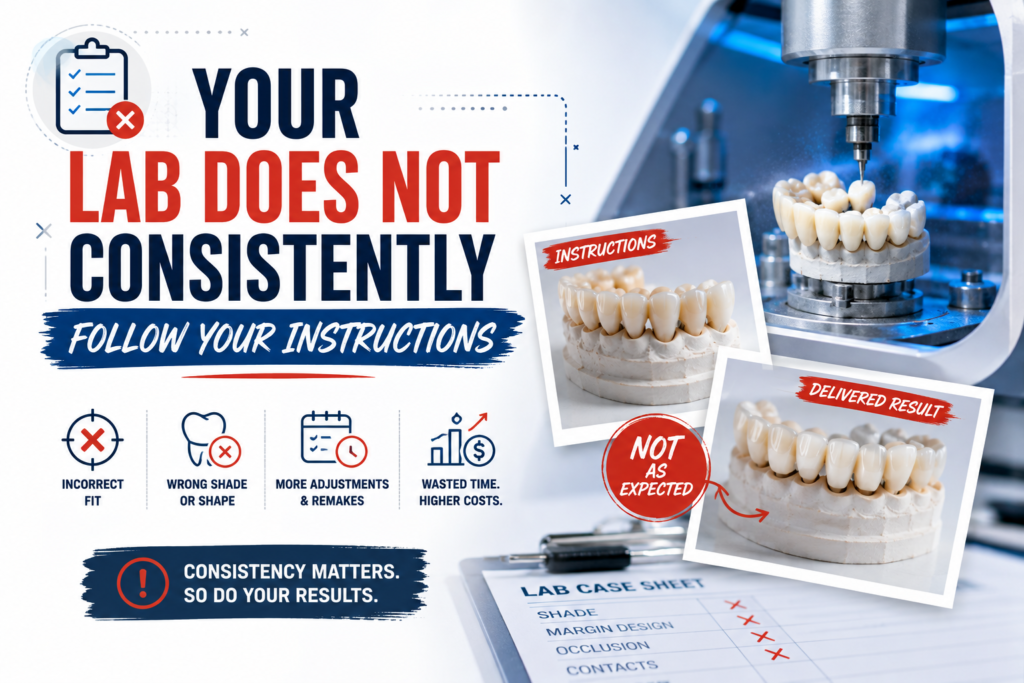
These may involve:
- Contact strength
- Occlusal design
- Margins
- Contours
- Shades
- Materials
- Implant components
- Emergence profiles
A good laboratory should learn these preferences over time.
Example: You have repeatedly requested a particular contact preference and included it clearly on prescriptions. Despite multiple discussions, the same issue continues appearing across similar restorations.
That is different from an occasional misunderstanding.
At the same time, a laboratory should not blindly follow an instruction when it identifies a potential technical problem. A strong lab will raise the concern and discuss the case with the dentist.
The best dentist-lab relationships are collaborative.
9. Your Practice Has Outgrown Your Current Dental Lab
Sometimes the problem is not that your laboratory has become worse.
Your practice has simply changed.
Perhaps you now:
- Submit more restorative cases
- Use digital impressions routinely
- Place more implants
- Offer full-arch treatment
- Perform more cosmetic dentistry
- Need faster case communication
- Require more technical consultation
Example: A practice initially sending ten routine crowns per month may later grow to forty restorative cases, several implant cases, and multiple full-arch cases each month.
The laboratory infrastructure required at those two stages can be very different.
Evaluate your laboratory based on what your practice needs today and where it is heading next.
10. You No Longer Consider Your Lab a Dependable Partner
Trust in a dental laboratory develops through repeated experience.
You should feel confident that your lab will:
- Review prescriptions carefully
- Follow agreed preferences
- Ask questions when required
- Maintain consistent standards
- Communicate delays
- Address problems professionally
- Support the cases it accepts
Over time, a strong laboratory learns your clinical preferences, materials, contacts, contours, shades, implant protocols, and communication style.
Your practice also learns how the laboratory operates.
If that relationship has broken down and repeated problems continue despite reasonable efforts to resolve them, it may be appropriate to evaluate another dental lab partner.
Before You Change Dental Labs: Review These 5 Things
Do not make the decision based on one difficult case.
1. Review 10–20 Recent Cases
Look for repeated problems rather than isolated incidents.
2. Document Adjustments and Remakes
Record what went wrong and what correction was required.
3. Compare Promised and Actual Turnaround Times
Do not make the decision based on one difficult case.
4. Review Your Clinical Records
Check scan or impression quality, prescriptions, photographs, bite records, implant information, and other case details.
5. Discuss Recurring Issues With Your Lab
Give your current laboratory an opportunity to investigate the pattern and propose a solution. This gives you a more objective basis for deciding whether the relationship can improve.
What Should You Look for in a New Dental Lab?
If you decide to evaluate another laboratory, do not compare crown prices alone.
Look for a lab that provides:
Consistent Restoration Quality
Ask how restorations are reviewed before delivery and how recurring quality issues are investigated.
Realistic Turnaround Times
The laboratory should provide timelines that your practice can actually use for scheduling.
Responsive Communication
You should know whom to contact when a case needs technical discussion.
Digital Workflow Compatibility
Confirm scanner compatibility, file submission procedures, digital photographs, models, and implant workflows.
For an authoritative external reference, consider linking effective digital lab communication to the American College of Prosthodontists’ educational resources on digital workflows.
Appropriate Complex-Case Support
If your practice handles implants, cosmetic rehabilitation, or full-arch treatment, ask specifically about the laboratory’s experience with these workflows.
Clear Pricing and Policies
Understand the laboratory’s policies regarding:
- Remakes
- Shipping
- Rush cases
- Implant components
- Materials
- Turnaround
- Additional charges
Questions to Ask Before Switching Dental Labs
Before sending your first case, ask:
- What is your typical turnaround time?
- Which intraoral scanners do you support?
- Which digital file formats do you accept?
- Which restorative materials do you offer?
- Which implant systems do you regularly support?
- How are remakes and adjustments handled?
- Who can I contact for technical case questions?
- How are complex cases reviewed before fabrication?
- What additional charges should I expect?
- How do you communicate delays or case concerns?
These questions help you evaluate the actual workflow behind the laboratory rather than making a decision based only on price.
Looking for a Reliable Dental Lab Partner?
If recurring adjustments, inconsistent quality, delays, digital workflow problems, or communication issues are affecting your practice, comparing another laboratory may help you determine whether a different workflow would be more suitable.
Palm Beach Dental Lab, based in Royal Palm Beach, Florida, supports dental practices with restorative, implant, full-arch, and digital laboratory solutions.
Our services include:
- Crowns and bridges
- Implant restorations
- PMMA Hybrid Full Arch Solutions
- Smile makeover cases
- Partial dentures
- Multilayered Zirconia Crown
- Additional dental laboratory services
Our goal is to make case submission, laboratory communication, fabrication, and delivery more efficient for the dental practices we serve.
Palm Beach Dental Lab also offers digital workflow support, free digital impression shipping, zero-cost 3D models, and fast turnaround options for qualifying cases.
Because turnaround times depend on the restoration, material, case complexity, and shipping requirements, contact our laboratory team for the expected timeline for your specific case.
Ready to discuss your next case?
Call Palm Beach Dental Lab at +1 (561) 603-0353.
Frequently Asked Questions
Consider evaluating another laboratory when repeated problems with adjustments, remakes, quality, turnaround time, communication, or digital workflows continue despite clear feedback and reasonable efforts to resolve them.
Usually not. A remake can result from several clinical or laboratory factors. Review multiple cases and identify the cause before making a decision.
A good dental lab should provide consistent restoration quality, clear communication, realistic turnaround times, transparent policies, appropriate technical capabilities, and dependable support for the cases your practice provides.
Digital compatibility is especially important for practices using intraoral scanners, CAD/CAM workflows, implant scan bodies, and digital photography. Technology alone, however, does not replace accurate records, good communication, and laboratory expertise.
Yes. Sending a limited number of suitable cases allows your practice to evaluate restoration quality, communication, turnaround time, case handling, and overall workflow before moving more work.
Should You Change Your Dental Lab?
Changing dental laboratories should be based on evidence rather than one frustrating experience.
Review restoration fit, adjustments, remakes, turnaround times, communication, prescriptions, digital compatibility, technical support, pricing, and your laboratory’s ability to manage the types of cases your practice currently provides.
Your own clinical records should also be part of the review. Strong dentist-laboratory relationships depend on accurate information and effective communication from both sides.
If recurring problems continue despite accurate records, clear prescriptions, documented feedback, and reasonable efforts to correct them, comparing another dental laboratory may be appropriate.
Ultimately, the right dental lab should do more than manufacture restorations. It should operate as a dependable technical partner that supports predictable workflows, consistent quality, clear communication, and the continued growth of your dental practice.