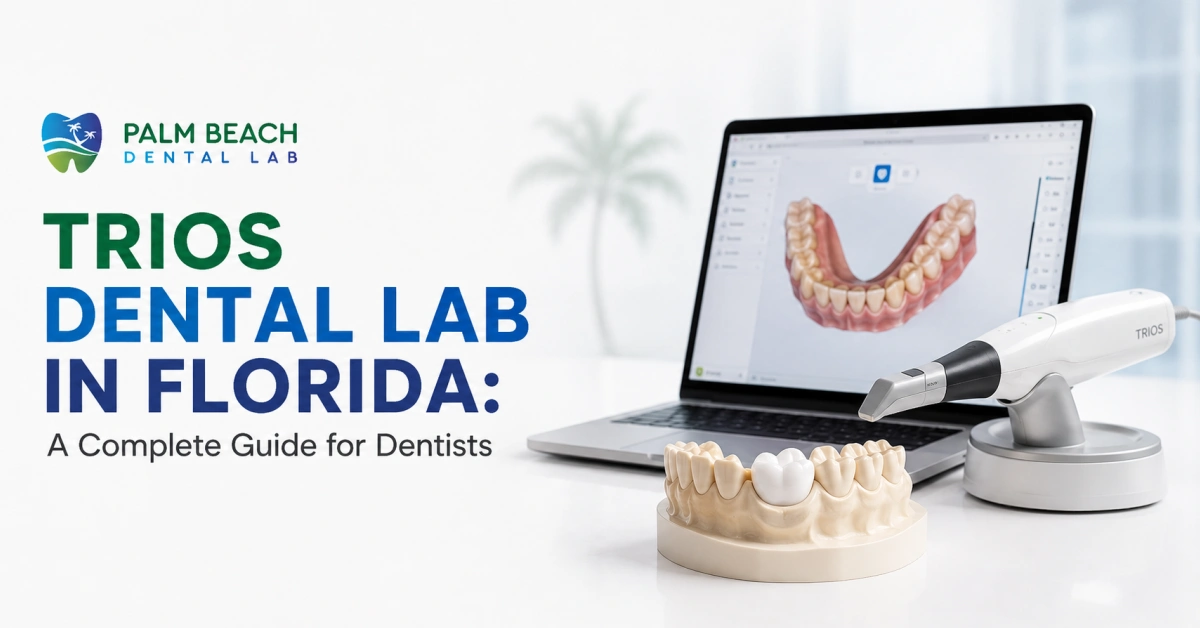
Digital dentistry has made restorative case submission faster and more convenient for dental practices. With a 3Shape TRIOS intraoral scanner, dentists can capture detailed digital impressions and send them electronically to a compatible dental laboratory without relying entirely on traditional impression materials and physical shipping.
However, a successful digital workflow involves more than simply scanning and sending a case. Scan quality, preparation visibility, bite records, prescription details, material selection, and communication with the dental laboratory can all influence how smoothly a restoration moves through production.
I’m Vijay Patel, a dental technician with more than 10 years of experience in the dental laboratory industry. In this guide, I’ll explain how the TRIOS digital workflow works, which restorations can be submitted digitally, common submission mistakes to avoid, and what dentists should consider when choosing a TRIOS Dental Lab in Florida.
What Is a TRIOS Dental Laboratory?
A TRIOS dental lab is a dental laboratory that can receive and work with digital impressions captured using a 3Shape TRIOS intraoral scanner.
Instead of taking a conventional impression and shipping it to the laboratory, the dentist scans the preparation, surrounding teeth, opposing arch, and bite digitally.
The scan can then be submitted electronically along with the laboratory prescription and any relevant clinical instructions.
Before the restoration enters production, the laboratory typically reviews the digital records to confirm that enough information is available for design and fabrication.
This review may include:
- Preparation margins
- Adjacent teeth
- Opposing dentition
- Bite relationship
- Available restorative space
- Scan completeness
- Shade information
- Implant information where applicable
- Clinical photographs when required
If important information is missing or unclear, the laboratory may contact the dental practice before beginning the case.
This early review can help prevent unnecessary delays later in the restorative process.
How the TRIOS Digital Workflow Works
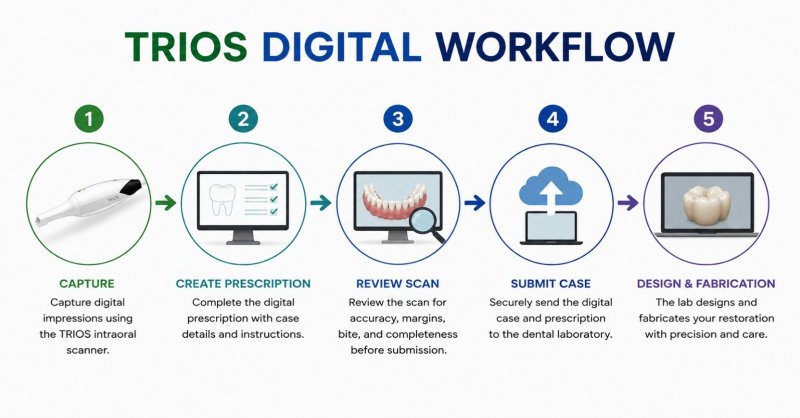
Although individual laboratory workflows can vary, most TRIOS cases follow a similar process.
1. Capture the Digital Impression
The dentist uses the TRIOS intraoral scanner to capture the preparation and relevant oral anatomy.
Depending on the restoration, the scan may include:
- Prepared tooth or teeth
- Adjacent teeth
- Opposing arch
- Bite registration
- Gingival tissue
- Implant scan body
- Edentulous areas
The goal is to provide the laboratory with a complete digital representation of the clinical situation.
2. Complete the Digital Prescription
The prescription tells the laboratory what needs to be fabricated.
Important information may include:
- Patient identification
- Tooth number
- Restoration type
- Material
- Shade
- Requested delivery date
- Implant system, if applicable
- Occlusal instructions
- Esthetic requirements
- Other clinical notes
Complete prescriptions reduce the need for additional communication after the case has already been received.
3. Review the Scan Before Submission
Before sending the case, the digital model should be examined carefully.
Check for:
- Clearly visible finish lines
- Complete preparation surfaces
- Fully captured adjacent teeth
- Complete opposing dentition
- Accurate bite registration
- Missing scan areas
- Distorted or duplicated surfaces
A few minutes spent reviewing the scan can often save more time later.
4. Submit the Case to the Laboratory
Once the scan and prescription are complete, the digital case can be transmitted to the laboratory.
The technician can then review the records and determine whether sufficient information is available to begin the restoration.
5. Design and Fabrication
After the case is accepted, the restoration moves into the digital design stage.
Depending on the restoration, the technician may evaluate:
- Margins
- Proximal contacts
- Occlusion
- Contours
- Material thickness
- Restorative space
- Emergence profile
- Esthetic requirements
The restoration is then fabricated using the appropriate laboratory process.
Digital technology can improve efficiency, but technician experience and quality control remain important throughout the workflow.
Why Scan Quality Matters
Using an intraoral scanner does not automatically guarantee a successful restoration.
The laboratory can only work with the information contained in the submitted records.
In my experience, many digital case delays are related to relatively simple issues such as unclear margins, incomplete bite records, missing anatomy, or incomplete prescriptions.
These issues can often be identified before the case is submitted.
Clear Preparation Margins
The finish line should be visible around the entire preparation.
If tissue, saliva, blood, or incomplete scanning obscures the margin, the technician may not have enough information to design the restoration confidently.
Complete Adjacent Teeth
The adjacent teeth provide important reference information for proximal contacts and restoration contours.
Accurate Opposing Arch
The opposing dentition allows the technician to evaluate occlusion and available restorative space.
Reliable Bite Registration
An inaccurate bite scan can affect the relationship between the restoration and opposing dentition.
Complete Scan Data
Any missing areas should be corrected before submission whenever possible.
Incomplete digital records may require additional scans and can delay production.
Restorations That Can Be Submitted Using TRIOS
Digital impressions can support many common restorative treatments.
The exact requirements will depend on the individual case.
Single Crowns
TRIOS scans are frequently used for single-unit restorations.
Depending on the clinical indication, these may include:
- Zirconia crowns
- Layered zirconia crowns
- Lithium disilicate restorations
- Other laboratory-approved materials
A clear preparation and accurate bite provide the laboratory with the information needed to evaluate the case.
Dental Bridges
Digital impressions can also be used for many bridge cases.
Because multiple units are involved, accurate scanning of the abutments, pontic areas, adjacent teeth, opposing arch, and bite is especially important.
Veneers
TRIOS scans can support veneer workflows, but esthetic cases often benefit from additional records.
Clinical photographs can provide useful information about:
- Shade
- Tooth shape
- Surface characteristics
- Incisal translucency
- Adjacent teeth
- Overall smile appearance
Inlays and Onlays
Digital impressions may also be used for indirect inlays and onlays.
The laboratory needs clear information about the preparation margins, contacts, occlusion, and available restorative space.
Implant Restorations
Digital implant cases may require additional information beyond the standard intraoral scan.
This may include:
- Correct scan body
- Implant system
- Platform or component information
- Soft tissue records
- Opposing dentition
- Bite registration
- Clinical photographs
Complete implant information is particularly important because restorative components vary between implant systems.
Full-Arch Restorations
Full-arch cases can require more extensive clinical records.
Depending on the treatment, the laboratory may request:
- Additional bite records
- Implant information
- Photographs
- Facial references
- Existing prosthesis records
- Treatment notes
- Other digital or physical records
Complex cases are often best discussed with the laboratory before submission.
Common TRIOS Scan Submission Mistakes
Many digital case problems are preventable.
Here are some of the most common issues dentists and clinical teams should check before sending a scan.
Unclear Margins
If the finish line is difficult to identify, the laboratory may need additional information or a new scan.
Incomplete Opposing Arch
Missing opposing anatomy can make occlusal evaluation more difficult.
Poor Bite Registration
An inaccurate bite can affect restoration design and occlusal adjustment.
Missing Prescription Details
Important information such as restoration type, material, shade, or clinical instructions should not be left unclear.
Incomplete Implant Information
Implant cases should include the relevant implant system and component details.
Missing Photographs for Esthetic Cases
Photographs are not required for every restoration, but they can be valuable for anterior cases where shade and characterization are important.
TRIOS Digital Impressions vs Traditional Impressions
Digital and conventional impressions can both be used successfully in restorative dentistry.
Each approach has advantages depending on the clinical situation.
Digital impressions can offer:
- Electronic case submission
- Immediate scan review
- Easier digital storage
- Faster communication
- Reduced dependence on physical impression shipping
Traditional impressions may still be appropriate for certain cases or laboratory protocols.
The important issue is not whether the impression is digital or conventional.
What matters most is whether the records are complete, accurate, and clinically useful.
A digital impression with missing margins or an inaccurate bite can create the same type of difficulties as an incomplete conventional impression.
How to Choose a TRIOS Dental Lab in Florida
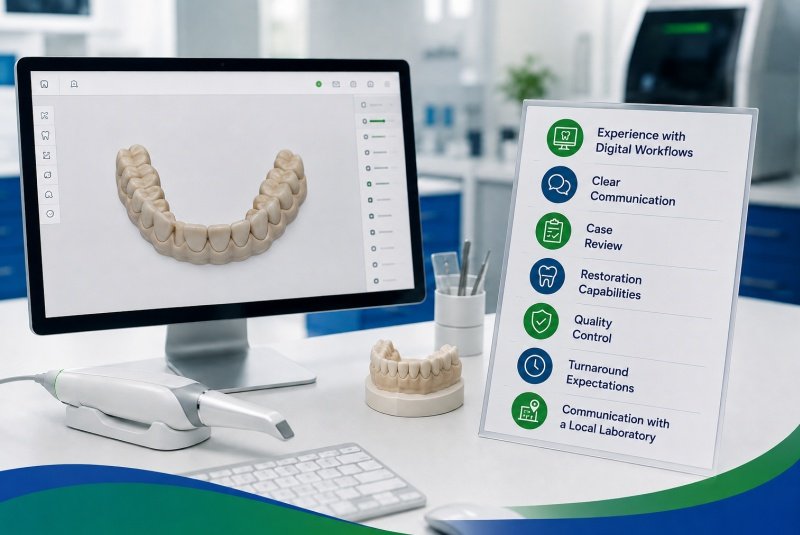
TRIOS compatibility should be only one factor when choosing a laboratory.
Dentists should also consider the laboratory’s experience, communication process, case review standards, and ability to support the restorations commonly prescribed by the practice.
Experience with Digital Workflows
The laboratory should understand how to review and work with intraoral scan data.
Technicians should also know when a case requires additional records before production begins.
Clear Communication
Good communication becomes particularly important for implant, cosmetic, and multi-unit restorations.
A laboratory should be willing to ask questions when clinical information is unclear rather than making assumptions.
Case Review
A consistent case review process can help identify issues such as:
- Missing margins
- Incomplete anatomy
- Bite concerns
- Implant component questions
- Prescription inconsistencies
Restoration Capabilities
Make sure the laboratory can support the types of cases your practice regularly submits.
These may include crown and bridge restorations, veneers, implants, or more complex restorative treatments.
Quality Control
Digital workflows still require careful laboratory quality control.
The scanner captures the clinical information, but technician decisions, material handling, finishing, and final inspection remain important.
Turnaround Expectations
Turnaround times can vary depending on the restoration and complexity of the case.
Ask the laboratory what to expect before submitting cases with specific delivery requirements.
Communication with a Local Laboratory
For Florida dental practices, working with a laboratory in the same state may make communication and case coordination more convenient.
Location should not be the only deciding factor, but easier access to the laboratory team can be useful when discussing complex or time-sensitive cases.
Tips for Better TRIOS Case Submissions
A consistent submission routine can improve communication and reduce avoidable case delays.
Before submitting a digital case:
- Check the complete preparation margin
- Review the opposing arch
- Confirm the bite
- Look for scan holes
- Include the correct shade
- Add clinical photographs for esthetic cases
- Provide complete implant information when applicable
- Include clear laboratory instructions
- Review the entire digital model before sending
One of the simplest habits is also one of the most useful: inspect the scan from multiple angles before submission.
Small missing areas are often easier to correct while the patient is still in the chair.
Frequently Asked Questions
Yes. Once the dental practice and laboratory are connected through the appropriate digital workflow, TRIOS scans can be transmitted electronically with the case prescription.
TRIOS scans can support crowns, bridges, veneers, inlays, onlays, implant restorations, and certain full-arch cases, depending on the clinical situation and laboratory requirements.
Yes. TRIOS digital impressions can be used for zirconia crown workflows when the preparation, margins, opposing arch, bite, and other required records are captured clearly.
Yes. Implant workflows may require the correct scan body, implant system information, component details, bite records, and other relevant clinical information.
The laboratory may contact the dental practice for clarification. Depending on the missing information, an additional scan may be required before the restoration can proceed.
No. However, clinical photographs can be particularly useful for anterior and cosmetic restorations where shade, surface characteristics, and tooth appearance need to be communicated.
Rotate and enlarge the digital model before submission. The finish line should be clearly visible around the preparation without missing scan data or tissue obscuring important areas.
Neither method is automatically better in every clinical situation. Both depend on proper technique and complete records. The most appropriate method depends on the case, dentist, and laboratory workflow.
Location can make communication more convenient, but it should not be the only consideration. Digital workflow experience, case review, restoration capabilities, communication, quality control, and turnaround expectations are also important.
Final Thoughts
TRIOS has made it easier for dentists to capture and submit restorative cases digitally, but a reliable digital workflow still depends on good clinical records and careful communication.
Clear margins, accurate bite records, complete prescriptions, appropriate implant information, and thorough scan review can all help the laboratory understand the case before production begins.
For dentists comparing a TRIOS Dental Lab in Florida, the most important consideration is not simply whether the laboratory accepts digital scans. It is whether the laboratory has a clear process for reviewing those records, identifying potential issues, and communicating when additional information is needed.
A good digital workflow should make restorative case submission simpler without removing the technician oversight and communication that remain important in laboratory dentistry.

Bio
A clean crown case starts with clear details, accurate scans, and strong lab communication. Vijay Patel, Owner and Dental Technician at Palm Beach Dental Lab, works with dentists on crowns, bridges, implants, removables, full arch cases, and digital restorative workflows. He focuses on helping dental practices reduce delays, remakes, and back-and-forth by submitting complete case records from the start.
Sending TRIOS Cases to Palm Beach Dental Lab
For dentists who use 3Shape TRIOS, Palm Beach Dental Lab accepts digital restorative cases and works with practices that prefer a digital case-submission workflow.
When a TRIOS case is received, the focus is first on reviewing the information provided rather than immediately moving it into production. Depending on the restoration, this may involve checking the preparation, opposing arch, bite, prescription details, shade information, implant records, or other case-specific instructions.
Palm Beach Dental Lab can work with digital cases such as:
- Crown and Bridge
- Dental Implants
- Full Arch
- Multilayered Zirconia Crown
- Dental bridges
- Implant-supported restorations
For dentists submitting a TRIOS case for the first time, it can be helpful to confirm the digital connection and laboratory requirements before sending the scan.
The aim is to keep the process straightforward: provide complete digital records, review the case before production, and communicate early if anything needs clarification.