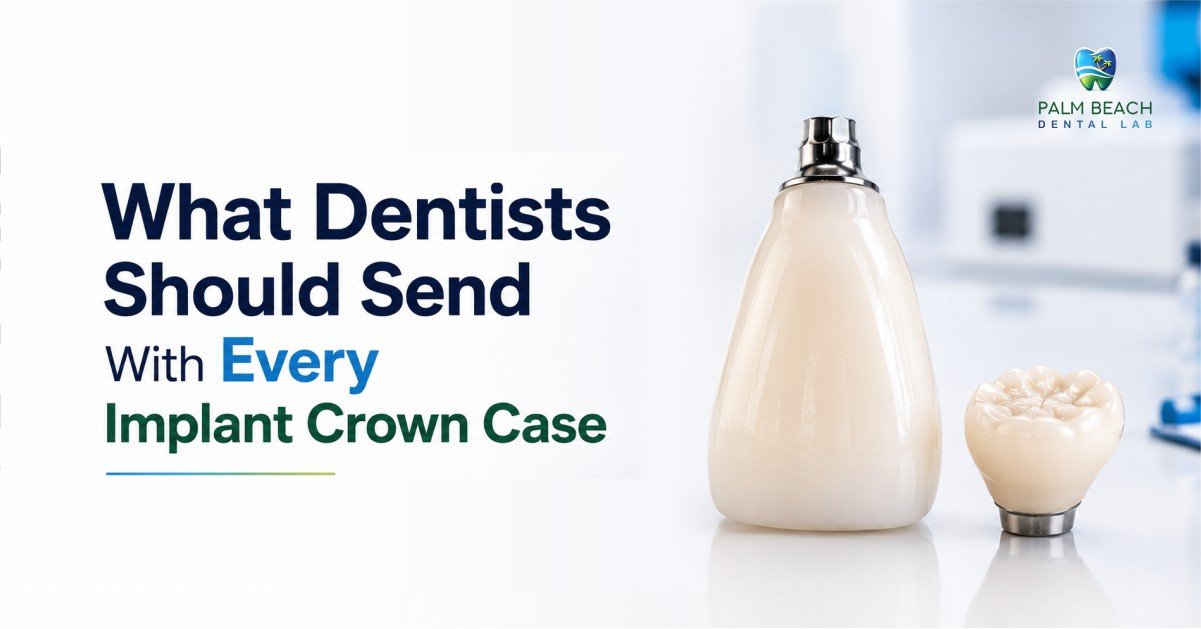
Successful implant restorations depend on more than clinical skill—they require complete and accurate communication with the dental laboratory. Missing records or incomplete case information can lead to delays, remakes, and unnecessary chair time.
I am Vijay Patel, a dental laboratory professional at Palm Beach Dental Lab with more than 10 years of experience working with implant restorations, crowns, and full-arch cases. In my experience, incomplete case submissions are one of the most common causes of treatment delays and remakes.
This guide outlines exactly what dentists should send with every implant crown case to help ensure accurate restorations, faster case processing, and predictable clinical outcomes.
Why Complete Implant Crown Case Information Matters
Providing complete implant crown case documentation allows the laboratory to fabricate restorations more accurately, reduce remakes, shorten turnaround times, and deliver better clinical outcomes for patients.
Incomplete implant cases often create avoidable complications, including:
- Delayed case processing
- Additional communication between the lab and practice
- Incorrect implant component selection
- Poor occlusal fit
- Esthetic discrepancies
- Increased chairside adjustments
A few extra minutes spent gathering complete records can save days of delays later in the treatment process.
Implant Crown Case Submission Checklist
1. Digital Scan or Conventional Impression
The foundation of every implant crown case is an accurate impression.
For digital workflows, ensure your intraoral scan includes:
- Implant scan body
- Adjacent teeth
- Soft tissue contours
- Complete arch anatomy
For conventional workflows:
- Verify impression material accuracy
- Confirm complete implant capture
- Check for voids or distortions
Poor impression quality is one of the leading causes of restoration inaccuracies.
2. Opposing Arch Records
The laboratory needs a clear representation of the opposing dentition to establish proper occlusion.
Providing opposing arch records helps technicians:
- Design proper occlusal anatomy
- Avoid premature contacts
- Improve patient comfort
- Reduce chairside adjustments
3. Accurate Bite Registration
An accurate bite registration ensures proper articulation of the case.
Key considerations include:
- Stable bite relationship
- Full seating during registration
- Accurate vertical dimension
- Clear posterior contacts
Even small inaccuracies can affect the final fit of the implant crown.
4. Implant System Information
One of the most important details in any implant crown case is the implant system itself.
Always provide:
- Implant manufacturer
- Implant diameter
- Platform size
- Connection type
- Implant location
Without this information, the laboratory may be unable to select the correct restorative components.
Abutment Information Every Lab Needs
Dental laboratories need clear information regarding the planned abutment and restoration design to ensure proper function, esthetics, and implant compatibility.
Stock vs. Custom Abutments
Dentists should specify whether the case requires:
- Stock abutment
- Custom titanium abutment
- Custom zirconia abutment
Custom abutments often provide improved emergence profiles and esthetic outcomes, particularly in the anterior region.
Screw-Retained vs. Cement-Retained Restorations
The laboratory should also know whether the restoration will be:
Screw-Retained Implant Crown
Benefits include:
- Retrievability
- Easier maintenance
- Reduced risk of excess cement
Cement-Retained Implant Crown
Benefits include:
- Improved esthetics in some cases
- Simpler restorative workflow
Clear communication helps ensure the restoration is designed appropriately from the beginning
Clinical Photos That Improve Implant Crown Results
Clinical photographs provide valuable information that cannot always be captured through scans or impressions alone.
Recommended photos include:
Full Smile Photos
Help evaluate:
- Smile line
- Facial symmetry
- Tooth display
Retracted Photos
Allow technicians to assess:
- Gingival contours
- Adjacent dentition
- Tissue health
Occlusal Photos
Provide additional anatomical details and support restoration design.
Shade Reference Photos
Photos taken with a shade tab improve communication and increase esthetic accuracy.
Clinical photographs often make the difference between a good restoration and an exceptional one.
Shade Selection for Implant Crown Cases
Accurate shade communication is essential for natural-looking restorations.
When submitting shade information, include:
- Primary shade selection
- Characterization details
- Incisal translucency requirements
- Stump shade when applicable
Digital Shade Matching
Many practices now utilize digital shade systems to improve consistency and reduce subjective interpretation.
Adjacent Tooth Analysis
Evaluating neighboring teeth helps laboratories replicate:
- Surface texture
- Color gradients
- Natural translucency
- Esthetic nuances
The more information provided, the more predictable the final esthetic result becomes.
Implant Crown Prescription Requirements
A complete prescription gives the laboratory the clinical direction needed to fabricate an accurate and functional restoration.
Your prescription should include:
- Restoration type
- Crown material
- Implant location
- Occlusal considerations
- Margin requirements
- Requested delivery date
Material Selection
Common options include:
Monolithic Zirconia
Ideal for:
- Strength
- Posterior restorations
- Long-term durability
Porcelain-Fused-to-Metal (PFM)
Still used in specific clinical situations where indicated.
Common Implant Crown Case Mistakes Dentists Make
Understanding common submission errors can help prevent delays and remakes.
Missing Implant Information
Failing to identify the implant system is one of the most frequent issues laboratories encounter.
Poor Scan Quality
Incomplete scans may require rescanning and increase turnaround time.
Missing Clinical Photos
Photos provide critical esthetic information often unavailable elsewhere.
Incomplete Prescriptions
Laboratories should never be left guessing about materials, design preferences, or restoration type.
Inaccurate Bite Records
Poor bite registrations often lead to occlusal adjustments and patient discomfort.
Digital Workflow Best Practices for Implant Crown Cases
Digital dentistry continues to improve communication between practices and laboratories.
Benefits of Digital Implant Workflows
- Faster case submission
- Improved accuracy
- Reduced remakes
- Better communication
- Increased efficiency
Intraoral Scanning Best Practices
For optimal results:
- Capture complete scan body geometry
- Ensure proper tissue management
- Verify scan quality before submission
- Follow manufacturer recommendations
Effective Communication With Your Laboratory
The most successful implant crown cases involve proactive communication between clinicians and technicians.
When questions arise, early collaboration often prevents costly corrections later.
How Palm Beach Dental Lab Supports Implant Crown Cases
At Palm Beach Dental Lab, we work closely with dentists across the United States to streamline implant crown workflows through advanced digital technologies and precise restorative solutions.
Our team specializes in:
- Implant crown restorations
- Custom abutments
- Digital workflows
- Full-arch restorations
- Complex implant cases
By combining modern digital processes with experienced technical support, we help dental practices reduce remakes, improve efficiency, and achieve predictable restorative outcomes.
Conclusion
A successful implant crown case depends on more than just a good impression. Complete documentation, accurate records, clear communication, and detailed prescriptions all contribute to predictable restorative outcomes.
By establishing a standardized implant crown submission process, dentists can reduce remakes, improve turnaround times, and deliver a better experience for their patients.
Whether you’re submitting a single-unit implant crown or managing a more complex restorative case, providing complete information from the start helps ensure success for both the practice and the laboratory.
Ready to Improve Your Implant Crown Workflow?
Palm Beach Dental Lab partners with dental practices nationwide to provide high-quality implant restorations, digital workflow support, and responsive technical expertise. Contact our team to learn how we can help streamline your next implant crown case and deliver predictable results with confidence.

Bio
A highly professional director at the Christine Blundell Make-up Academy, Petar Agbaba brings a wealth of experience and expertise to his writing. With an in-depth knowledge of makeup courses and techniques, he crafts insightful, well-researched content that resonates with readers. Known for his clarity and authenticity, Petar is a trusted voice in the beauty industry, consistently delivering valuable perspectives through his work.